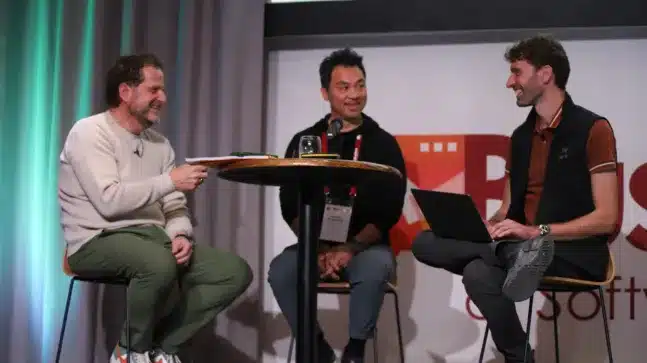
This week Jason Fried, the founder of 37signals and author of Rework, joins us on Jobs-to-be-Done Radio to discuss how he came to discover the JTBD framework and apply it to Basecamp and how he does things at 37signals.
Jason was first introduced to the Jobs-to-be-Done concept by another 37signals team member, Ryan Singer. As the story goes, Ryan saw Clay Christensen describe how he and a colleague uncovered the jobs that a milkshake does in a web video. After watching the video, Ryan went on a search to find out who the “milkshake man” was, and found Bob Moesta and Chris Spiek from the Re-Wired Group. (more…)
0 Comments

This week we’ll give you a glimpse into what went on at the Switch Workshop that was held at the 37signals office in Chicago on October 1st.
We’re joined by Nick Owsley, the co-founder of PromoSimple, who shares his thoughts about being an attendee, and the steps that he’s taken to understand the jobs that his product does since he left the event.
Nick joined 23 other attendees (mostly entrepreneurs, start-up founders, and product/marketing individuals in the software and technology space) at 37signals to spend a day learning about one of the fundamental premises of Jobs-to-be-Done: People don’t just buy or start using your product. They stop doing one thing, and start doing something else.
Using that premise as a starting point, the attendees at the workshop were exposed to the way that we conduct consumer interviews at Re-Wired, in an attempt to uncover the progress that a consumer is trying to make when they hire a product or service. After watching a number of off-the-cuff live interviews (people that we picked out of the audience), the attendees spent time learning more about the details of the Jobs-to-be-Done Framework, and then broke into groups to conduct interviews of their own.
In this episode, Nick talks us through the experience of conducting his first JTBD interview with a customer and gives his candid review of the Switch Workshop.
Listen to the Show
Podcast: Play in new window
Subscribe
Make sure you don’t miss upcoming episodes! Subscribe to Jobs-To-Be-Done Radio using this feed.
iTunes/iPhone users can new subscribe to this Podcast in iTunes!
0 Comments

This week we continue to share audio of a recent trip to Boston to visit Clayton Christensen. Clay shares the story of when Andy Groves of Intel asked him to explain how disruption would affect his company. He reinforces for us the concept that when applying a framework such as Jobs-to-be-Done, it’s always important to show people how to think, not what to think.
A framework such as Jobs-to-be-Done should give you a common language and a common way to frame the problem so that you can reach consensus around a counter-intuitive course of action.
This week we also say farewell to Tom McBrien, the 2012 Summer Intern at the Re-Wired Group. Tom walks us through his experience at Re-Wired, including his take on how Jobs-to-be-Done helped him understand the importance of causality, how it prompted him to think hard about the job that he was hiring college for, and how it eventually prompted him reconsider his major at the University of Michigan.
Listen to the Show
Podcast: Play in new window
Subscribe
Make sure you don’t miss upcoming episodes! Subscribe to Jobs-To-Be-Done Radio using this feed.
iTunes/iPhone users can new subscribe to this Podcast in iTunes!
1 Comment
This week Bob and Chris are honored to be joined by Clayton Christensen on Jobs-to-be-Done Radio. Clay discusses why he thinks the JTBD framework is so important and talks through how it is used to understand causality and what drives consumer to buy.
He also uses OpenTable as an example of a company that has experienced success by nailing the job-to-be-done and understanding the progress-making-forces at play when making a reservation at a restaurant.
Also, be sure to check out Taddy Hall’s recent article in Time: Differentiation: A Surprising Story of Sameness.
Listen to the Show
Podcast: Play in new window
Subscribe
Make sure you don’t miss upcoming episodes! Subscribe to Jobs-To-Be-Done Radio using this feed.
iTunes/iPhone users can new subscribe to this Podcast in iTunes!
Coming Up Next Week
We’ll be joined by Tom McBrien, an intern at The Re-Wired Group to discuss our method of pulling out dimensions and coding interviews.
0 Comments
This week presented a great opportunity to bring some special guests to the Jobs-to-be-Done Radio Show.
Bob and Chris are joined by John Palmer, who worked with Bob in the early 90s to create the Jobs-to-be-Done Framework, as well as Bob Barrett and Ervin Fowlkes who are colleagues at The Re-Wired Group.
In the middle of an intense two-day working session focused on identifying the Jobs-to-be-Done in some specific situations for two of our clients, we decided to take a break from the work and discuss summarizing a job-to-be-done in 140 characters or less.
In an earlier Twitter exchange on the #JTBD hashtag, Chris took the stance that distilling Jobs down to short phrases and sentences would risk losing the essence of the Job. Listen to the show to hear John Palmer how it is possible, and necessary to explain Jobs succinctly using images or icons.
Listen to the Show
Podcast: Play in new window
Subscribe
Make sure you don’t miss upcoming episodes! Subscribe to Jobs-To-Be-Done Radio using this feed.
iTunes/iPhone users can new subscribe to this Podcast in iTunes!
Coming Up Next Week
We’ll unpack some of the interviews that we have conducted in the building space to gain an understanding of how demand dimensions are identified.
0 Comments

This week’s show features guest Stephen Mohan, Managing Director of Operational Services of Cofunds. Stephen joins us to talk about financial services through the lens of Jobs-to-be-Done.
We contrast how the financial planner’s view of the competitive set (retirement plans, mutual funds, stocks) differs from the competitive set that consumers construct (buy what I want now and go into debt, keep my money as cash to avoid risk, do nothing). The discussion then moves into the solution space, and we talk about a few methods that financial planners could use to match their offering to what consumers are looking for in order to draw more people into the market.
Listen to the Show
Podcast: Play in new window
Subscribe
Make sure you don’t miss upcoming episodes! Subscribe to Jobs-To-Be-Done Radio using this feed.
iTunes/iPhone users can new subscribe to this Podcast in iTunes!
Coming Up Next Week
We’ll discuss Facebook’s new Facebook Camera offering and how they’ve leveraged the Instagram offering; Instagram for Video, and Social TV.
0 Comments
This week’s show starts out with a discussion around the swell of recent media that the Jobs-to-be-Done framework has received. We discuss the recent jobs-to-be-done Forbes article, as well as Clay’s guest appearance on the Critical Path radio show.
We also begin to explore the concept of engagement in the shopping process. We attempt compare and contrast the shopping behaviors of consumers as they purchase various products with seemingly low engagement (margarin, laundry detergent) with their behaviors as they purchase products with high engagement (homes, cars).
Finally, we hand out our first ever Jobs-to-be-Done Award to this week’s winner, Hello Fax. Listen in to hear about how the leadership team at Hello Fax has managed to zero in on a key job-to-be-done that exists in the document faxing market.
Listen to the Show
Podcast: Play in new window
Leave us your feedback and let us know what you think about the show!
Coming Up Next Week
We’ll continue our discussion on engagement, evaluate the pressure that Instagram is experiencing to move into the video space, and talk about Bob’s recent trip to France and the conversations he had around JTBD in the financial space.
Make sure you don’t miss upcoming episodes! Subscribe to Jobs-To-Be-Done Radio using this feed.
iTunes/iPhone users can new subscribe to this Podcast in iTunes!
0 Comments
We had each just consumed one giant carne asada burrito and a small basket of chips in the Mission District. We were sitting at Cancun Taquiera, a small, hyperactive taco restaurant across from Beauty Bar at Fulsom and 19th, or close to that.
Homeless people were walking in and asking for food from diners’ plates. My friend, J., was feeling a little overwhelmed. She’s used to a very clean, very non-homeless section of Orange County, right near the beach. We finished our meal. I felt satiated. She seemed to feel satiated, and a little tired, so we walked back up the small hill to the apartment and came to a stop at the corner near a convenience store.
“You want to get some drinks for the house,” she asked. Sure. We pop in. We get some drinks out of the cooler. She goes around the corner in the store and comes back with a Snickers bar.
“It’s after midnight, are you really going to eat that now,” I ask, laughing. “We just had burritos.” I’m staring wide-eyed.
“I really really want one. I gave mine away at the airport to the guy at the counter. He was really nice to me, he had a long day and he helped me with my bags,” she says. This is common behavior. J. is regularly giving things to people.
That made sense. And then I don’t think much more about it. This morning, there is still a Snickers bar sitting on the table. She hasn’t eaten it.
A case for Jobs-to-be-Done.
I won’t go into the whole timeline features or the questions and answers, but it comes out that J. didn’t hire the Snickers bar to eat the Snickers bar. She wasn’t even hungry for it. She was hungry for the Raisinettes that she bought in addition to the Snickers bar. She bought the Snickers bar because she lacked something. It wasn’t hunger. It wasn’t a desire for that creamy caramel nougat goodness.
There were deeper emotional reasons for wanting the candy bar. It offered security, comfort, a feeling of safety even. It gave her something nostalgic, and she had given hers away as an act of kindness and, in a way, wanted to reward herself for a good day.
But the main theme of our discussion was that J. had a “keep it for later” mentality. It was not so important that she ate it, but that she had it for later. It is likely that neither of us will eat the Snickers bar today, but it is going into the car anyway, to see what happens.
I shall report later on what job we hire the Snickers bar to do later on in San Francisco.
0 Comments
Would that school were so easy.
You go to school to learn something. You take that something and use it in the real world to get things done.
But what if the world changes so fast that the nineteenth century sysetm you are learning in does not prepare you for the 21st century world you go home to live in, use the web in, make your friends in?
You end up disrupting education by finding your own consumption. And that has consequences — some great, some maybe not so great.
Has Traditional Education Jumped the Shark?
What happens when the school you go to is online, free and part of an experiment? What if it’s a test, and not really part of the formal system? Do you lose out by learning in it?
What matters most — that you experienced the very same experience as your “cohort,” or that you learned the skills that you need to get a job?
We are starting to see this kind of question a lot when we look into how different people hire school to get the job of education done.
When education looks different, but creates the same result, what are the tensions that one experiences when trying to use the byproduct of that education to get hired? This question on Quora makes us wonder. The asker of the question offers context:
I’m currently taking part in a free programming course with Stanford University, and I’m watching the same lectures and doing the same work as real students, just not getting a degree out of it. Is it appropriate to include this on my CV/LinkedIn profile?
Here are my questions:
1. If the guy learns skills from this course, but does not get a degree, and he can perform the job that having the degree would indicate he could perform, then what use is the degree?
2. What is more important to an employer — the skill or the degree?
3. Do we rely on the degree because the people who hire us are often people who are not specialists in that field — I’m thinking of an HR manager here, who must have to use degrees to vet applicants.
Future thinking: we can take this thinking to its long-term conclusions. What if education evolves into something that is more about showing your work, or proving that you can solve problems in teh real world? Is it stilla bout the degree? Does the degree become something that proves that, or does the work itself prove that?
If it is the work itself, then what is more important? Is it your relationship in the school, or your relationship in the community?
I think that education institutions give people a bigger platform on which to stand, to build greater relationships with community. But as internet technology deconstructs those platforms, you have to consistently see these things differently. If social web technologies are their own platforms, and one can use those to connect to communities, then what happens to education?
As I have written before, in education there are often more questions than real market forces. If we could experiment more and more with education, we would find the answer to these questions come readily. If we could see real “market forces,” like teachers giving active and ready insight into how they use products, or if there was less overhead to deal with (bureaucracy and red tape), then developers and entrepreneurs could make the changes that would facilitate better learning.
Back to the original point: when students are given access, outside of the system, to newer ways to learn, those choices end up part of the market forces in the equation, and teachers, or anyone who does not participate, becomes further isolated.
My gut instinct says that many who are in education and who make their living from it, are wary of exploring this too much. Realistically speaking, they may feel their livelihood is at stake.
I think it’s not at stake, but it changes. Teachers — in K12 all the way through higher ed — have to change their roles the way reporters in journalism institutions do. It is more important to be facilitator to the hyper-informed community than it is to be the broad generalist who seeks to be the single conduit for information.
Teaching moves from lecturing, monitoring, coaching and mentoring, to curating, guiding, disrupting, and platform leveling. It’s more a task of community management than it is a teacher role.
1 Comment
Here’s today’s link to Quora, which I find to be most interesting because it shows two CEOs going head to head to define how one’s product is different than the other’s offering.
Can you spot the CEO who might have a knack for Jobs-to-be-Done?
Jonathan Stein, Founder and CEO of Betterment, describes his product in comparison to Andy Rechleff, founder and CEO of Wealthfront.
Though the question asked how the two differ from each other, you can see two really different characterizations of the investment market.
1 Comment